Mechanistic Benchmarking Report
A comparative assessment of a therapeutic programme's mechanistic profile - how its dependency burden, architecture, and fragility compare to comparable programmes, and what that position implies.
The Mechanistic Benchmarking Report (MBR) positions a programme's mechanistic profile relative to defined reference populations. It draws on the same dependency decomposition and fragility assessment that underpins the Mechanistic Due Diligence Report, but applies them comparatively - asking not only what is this programme dependent on? but how does that profile compare to comparable programmes, and where does it sit within the distribution?
The MBR benchmarks four dimensions: dependency burden (how many dependencies the programme carries), dependency architecture (how those dependencies are distributed across layers and centrality classifications), fragility domain distribution (how the programme scores across the five fragility domains), and integrated fragility distribution (how many dependencies resolve as Robust, Conditional, or Brittle). Each dimension is benchmarked against nested reference populations, with outcome-stratified comparison providing the primary interpretive context.
The MBR is a comparative product. It does not predict outcome. It describes where a programme sits relative to comparable programmes, and whether its profile resembles the profiles associated with success or failure in similar development contexts.
A complete MBR contains:
-
The programme's identity, mechanism of action, target, modality, and development stage.
-
The programme's dependency inventory, as assessed in the underlying MDDR framework.
-
The nested reference populations used for benchmarking: the MAFI database, the therapeutic area, the modality, the comparable cohort, and the outcome-stratified comparable cohorts.
-
The programme's total dependency count, positioned against the distribution of dependency counts within each reference population.
-
The distribution of the programme's dependencies across layers and centrality classifications, compared against reference population distributions.
-
The programme's domain-level score distributions, compared against reference populations for each of the five fragility domains.
-
The programme's distribution across Robust, Conditional, and Brittle tiers, compared against reference populations and against outcome-stratified cohorts.
-
For each of the programme's critical dependencies, an analysis of whether the same fragility configuration has occurred historically within the database, and how matched programmes were distributed across successful and failed outcomes.
Key Outputs
Outcome-Stratified Benchmarking
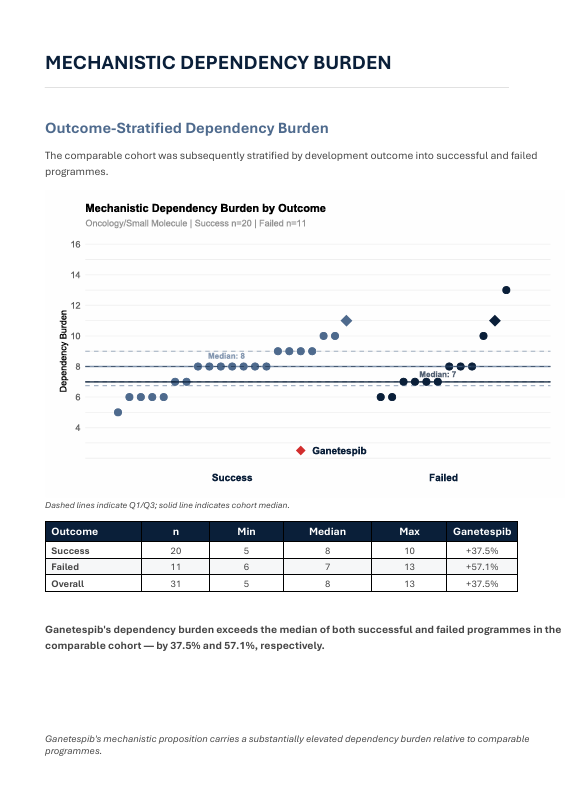
The MBR benchmarks a programme's profile separately against successful and failed comparable programmes. This allows the programme's mechanistic characteristics to be interpreted against the profiles associated with each outcome, without collapsing outcome into a single reference.
For Ganetespib, the programme's dependency burden exceeds the median of both successful and failed comparable programmes - by 37.5% and 57.1% respectively. This is a non-obvious finding: the programme is not just elevated relative to its peers, it is structurally anomalous even among failures.
Integrated Fragility Distribution
The MBR positions a programme's distribution across fragility tiers against reference populations. This is the summary measure of programme fragility, and it is often the most discriminating benchmark.
Ganetespib has no Robust dependencies - compared with approximately 10% Robust dependencies among successful comparable programmes. Its 36.4% Brittle proportion aligns more closely with the failed comparable cohort (37.9%) than the successful comparable cohort (21.9%).
Critical Dependency Convergence
For each of the programme's critical dependencies, the MBR identifies whether the same fragility configuration has historical precedent within the database, and how matched programmes were distributed across outcomes.
This is the bridge from description to positioning. It converts the framework from a static assessment into a comparative instrument — showing not just where the programme sits, but whether its critical configurations have been seen before, and with what results.