Mechanistic Due Diligence Report
A structured assessment of a therapeutic programme's mechanistic dependencies - where the mechanism is fragile, and where failure is most likely to originate.
The Mechanistic Due Diligence Report (MDDR) decomposes a programme's claimed mechanism of action into its individual mechanistic dependencies - the independently falsifiable propositions upon which the therapeutic thesis rests. Each dependency is assessed across five fragility domains, integrated into a fragility tier, and evaluated for centrality. The result is a structured view of where the mechanism is robust, where it is fragile, and which dependencies represent the programme's most consequential points of potential failure.
The MDDR is a diagnostic assessment. It does not predict outcome. It identifies the conditions that must hold for the mechanism to succeed, and the points at which those conditions are most likely to break down.
A complete MDDR contains:
-
The programme's identity, mechanism of action, target, modality, and development stage.
-
A reconstruction of the programme's biological rationale, from publicly available sources.
-
A complete list of the mechanistic dependencies identified through structured decomposition of the claimed mechanism.
-
A structural view of how those dependencies are distributed across biological, translational, clinical, and strategic layers, and how they are classified by centrality.
-
A domain-by-domain assessment of each dependency, with integrated fragility tiers.
-
The dependencies whose failure would produce the greatest adverse effect on the claimed mechanism, identified by combining centrality and fragility.
-
A structured stress test that traces how failure at a critical dependency would propagate through the programme's architecture to clinical and programme-level consequences.
-
Comparison with historical programmes that relied on analogous mechanistic dependencies, providing contextual precedent.
Key Outputs
Critical Failure Nodes
The MDDR identifies not just which dependencies are fragile, but which fragile dependencies matter most. By combining centrality and fragility, it isolates the dependencies whose failure would fundamentally undermine the therapeutic thesis - the points at which the mechanistic chain is most vulnerable.
For Ganetespib, this analysis identified four critical dependencies concentrated in the Biological layer, forming a sequential chain from tumour-cell dependence on HSP90 client proteins through to the persistence of the antitumour effect in the presence of resistance mechanisms.
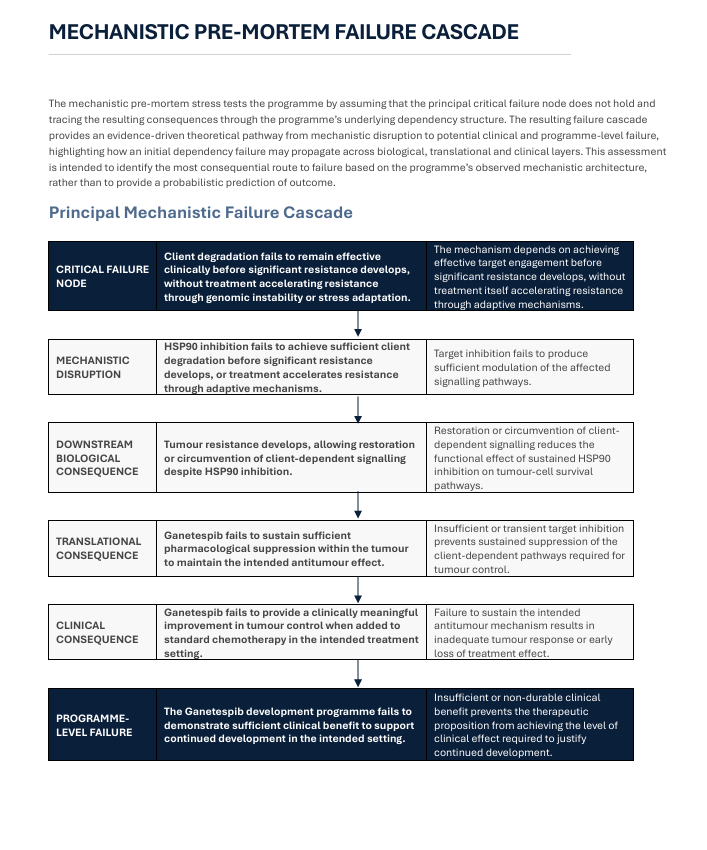
Mechanistic Pre-Mortem Failure Cascade
The pre-mortem assumes the principal critical failure node does not hold, and traces the consequences through the programme's dependency architecture - from mechanistic disruption, through biological consequence, to translational and clinical failure.
This converts a static assessment into a dynamic model of how failure could propagate. It is the analytical payoff of the framework.
Dependency Architecture
The MDDR maps the mechanism as a dependency structure - not as a narrative, not as a list of risks, but as a layered architecture with defined nodes and centrality classifications.
This visual is often the first thing a reader understands about the framework; that mechanism is a chain, and the chain has weak links.